
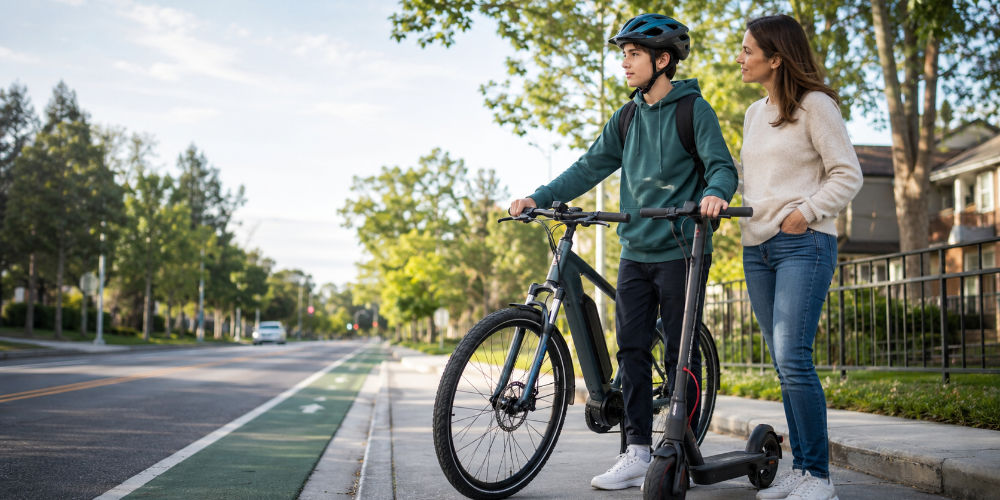
For many parents, the conversation begins innocently enough: “Mom, everyone has one.”
Electric scooters and e-bikes have quickly become some of the most desirable ways for children and teenagers to get around. They offer independence, make trips to school or a friend’s house easier, and can seem like a practical alternative to being driven everywhere.
But for moms and other parents deciding whether an e-scooter or e-bike is appropriate for their child, there is an important reality to understand: these are motorized vehicles, not simply bicycles or scooters with batteries attached.
They accelerate quickly, can reach significant speeds and place young riders in an environment shared with cars, cyclists, pedestrians, intersections, driveways and unpredictable road hazards. Canadian pediatric specialists are sufficiently concerned that the Canadian Paediatric Society (CPS) advises that children younger than 16 should not operate e-scooters or e-bikes or ride on them as passengers.
That recommendation may surprise many parents. The injury numbers help explain why.
The injuries are increasing in Canada
Canadian hospitals are seeing more injuries associated with e-scooters and e-bikes, including serious injuries.
The Canadian Institute for Health Information reported a 22% increase in hospitalizations resulting from e-scooter injuries across Canada. Physicians interviewed by CIHI described fractures and brain injuries among the cases they are treating.
Earlier Canadian surveillance provides another warning sign for parents. A Public Health Agency of Canada analysis identified 523 motorized-scooter injuries in the Canadian Hospitals Injury Reporting and Prevention Program between 2012 and 2019. Children aged 10 to 14 represented the largest age group, accounting for 34.4% of the injuries. Falls accounted for 56% of cases.
These figures predate much of the recent expansion in privately owned e-scooters, making the continuing increase particularly important.
The CPS notes that common injuries include head injuries, broken bones and cuts and warns that electric devices can accelerate rapidly and may travel at approximately 30–50 km/h, depending on the device.
What is happening outside Canada?
The Canadian experience is not occurring in isolation.
A recent U.S. pediatric study examining e-scooter injuries from 2014 through 2023 estimated more than 63,000 pediatric injuries over the study period. The average injured child was approximately 12 years old.
Fractures accounted for 28.5% of injuries, while the head was the most commonly injured individual body region, representing 17.7%. Falls from the scooter accounted for 69.1% of cases. Among injury records that documented helmet use, almost three-quarters indicated that the child was not wearing one.
The most recent U.S. Consumer Product Safety Commission analysis demonstrates the scale of the problem across all ages. The CPSC estimated approximately 79,300 emergency department treated e-scooter injuries in the United States in 2024 alone.
Helmet use was remarkably low among the e-scooter injury cases examined in its detailed follow-up study: only 18% involved a rider reported to be wearing a helmet.
The same CPSC report found fractures among the most common diagnoses and identified the upper limbs, lower limbs, head and neck as frequently injured areas.
These aren’t reasons for panic. They are reasons for parents to treat the decision differently from purchasing a skateboard, traditional scooter or ordinary bicycle.
The biggest concern may be speed
One of the challenges for parents is that an e-scooter looks relatively harmless while standing in the garage.
At speed, the situation is very different.
A conventional bicycle generally requires the rider to generate the energy needed to accelerate. An electric motor can deliver speed almost immediately. A young rider may therefore find themselves travelling faster than their hazard-recognition, decision-making and vehicle-control abilities can comfortably manage.
And traffic rarely provides much warning.
A car emerges from a driveway. A pedestrian steps into a bike lane. A door opens. A pothole appears. Traffic lights change. Another teenager rides alongside. A phone notification arrives.
The safety question isn’t simply whether a child can operate the device.
The Micromobility Safety Series
It is whether they can recognize what is developing around them early enough to avoid the collision.
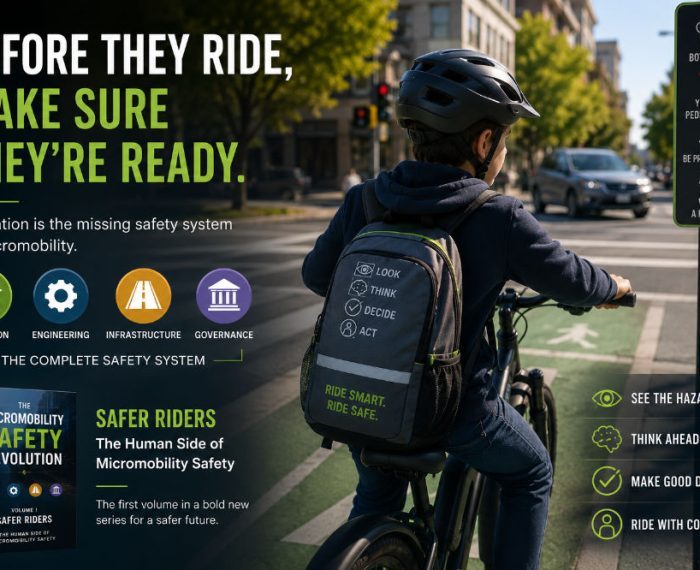
The complete blueprint for Micromobility Safety – the Rider, the Machine, and the City
“My child is responsible” isn’t the whole answer
Parents know their children better than anyone. A mature 15-year-old may behave very differently from an impulsive one.
But maturity is only part of the issue.
Safe riding requires coordination, visual scanning, speed selection, braking judgment, understanding of traffic rules, anticipation of other road users and the ability to resist peer pressure. CPS specifically notes that younger riders may not yet possess the strength, coordination and experience needed to operate powered devices safely.
That means a child can be responsible, careful and well-intentioned, yet still lack the experience to recognize a dangerous situation early enough.
Helmets are essential – but they don’t prevent crashes
A properly fitted, standards-approved helmet should be non-negotiable whenever someone rides an e-bike or e-scooter.
But parents should avoid viewing the helmet as the complete safety solution.
A helmet is primarily injury protection. It does not stop a rider from entering an intersection at the wrong moment, travelling too quickly for conditions or failing to detect an approaching vehicle.
The more important objective is preventing the crash from happening in the first place.
Parents who allow an older teen to ride should establish clear conditions: an approved helmet every trip, no passengers, no phone use while moving, appropriate speed for the environment, high visibility, lights when required and preference for protected cycling infrastructure or quieter streets. Those precautions broadly align with CPS recommendations.
Parents should also understand exactly what they are buying. Maximum assisted speed, throttle operation, braking performance, tire size and device weight can vary considerably.
And faster is not necessarily better.
The missing piece: teach riders how to avoid the collision
A helmet can reduce the severity of some injuries. Better equipment can improve braking, visibility and stability. Rules can tell a rider where they are permitted to travel.
But none of those things, by themselves, teach a young rider how to recognize a collision before it develops.
That is why specialized rider education needs to become part of the conversation whenever parents are considering an e-bike or e-scooter for a teenager.
These vehicles operate in a motorized road-risk environment. Riders encounter turning vehicles, blind driveways, opening car doors, intersections, pedestrians, cyclists, parked vehicles, surface hazards and drivers who may simply fail to see them. At 20, 25 or 30 km/h, a situation that initially appears harmless can become critical in only a few seconds.
Knowing how to balance, accelerate and brake is therefore not the same as knowing how to ride defensively.
A young rider needs to learn where danger is likely to come from, how to scan beyond the immediate path ahead, how to recognize the early clues that another road user may make a mistake and how to preserve enough time and space to respond safely.
In other words, the goal should not simply be teaching children how to control the vehicle. It should be teaching them how to manage risk.
From reacting to predicting
Traditional safety advice often focuses on what to do once something goes wrong: brake harder, swerve or attempt to avoid the obstacle.
Defensive-riding education should begin earlier.
The better approach is:
See the Danger. Predict the Mistake. Avoid the Collision.
That means teaching riders to identify a vehicle waiting to turn before it moves; to recognize that a parked car may conceal an opening door or pedestrian; to anticipate that a driver approaching an intersection may not yield; understand why positioning beside a large vehicle can place them in a blind spot; and adjust speed and road position before the potential conflict becomes an emergency.
This predictive approach is particularly important for young and inexperienced riders because experience is what eventually teaches road users to recognize patterns of danger. Structured education can help begin building that awareness intentionally rather than relying entirely on years of trial and error.
Defensive rider training should become the norm
Parents would rarely hand a teenager the keys to a motor vehicle and simply say, “Be careful.”
Motorized micromobility deserves a similar respect for education.
Young Drivers of Canada has extended its decades-long collision-avoidance philosophy into Defensive Rider programs designed specifically for e-bike and e-scooter riders. The programs focus on helping riders recognize, anticipate and avoid the situations that lead to collisions rather than merely teaching the mechanics of operating the device.
The philosophy is deliberately simple:
See the Danger. Predict the Mistake. Avoid the Collision.
Riders learn to think ahead of the immediate moment – to look for developing hazards, anticipate the mistakes that motorists, pedestrians and other road users may make, manage speed and space proactively, and make decisions early enough that emergency manoeuvres become less necessary.
That distinction matters.
The safest rider is not necessarily the one who can brake the fastest after a vehicle suddenly turns across their path.
It is the rider who recognized several seconds earlier that the vehicle might turn, reduced speed, changed position and prevented the emergency from developing in the first place.
For parents, education should be part of the purchase
If an e-bike or e-scooter is going to become a teenager’s first powered vehicle, then credible rider education should be considered part of the safety equipment – alongside the helmet, lights, brakes and appropriate protective gear.
Before allowing a young person to ride independently, parents should be able to answer another important question:
Has my child actually been taught how to avoid a collision, or have they simply learned how to operate the vehicle?
That may be one of the most important distinctions a family can make.
The objective is not to make young people afraid of riding. It is to give them the skills, judgment and predictive awareness to enjoy the independence micromobility can provide while understanding the risks that come with sharing a road environment with much larger and faster vehicles.
For families considering an e-bike or e-scooter, the formula should therefore be simple:
The right rider. The right vehicle. The right protective equipment. The right rules. And the right education.
Don’t overlook the battery
There is another concern that happens when the vehicle isn’t moving at all.
E-bikes and e-scooters use high-energy lithium-ion batteries. Health Canada has warned that damaged, improperly modified or incompatible batteries and chargers can create serious fire hazards. The agency cited reports from the United States of at least 208 e-mobility battery fire or overheating incidents across 39 states during 2021–2022, associated with at least 19 fatalities.
Because when a young person’s safety is at stake, learning how to ride should mean much more than learning how to make the vehicle move.
Parents should purchase reputable products, use the manufacturer’s specified battery and charger, avoid modified battery packs and stop using batteries showing signs of damage, swelling or overheating.
Before you say yes, change the question
For a parent, the decision shouldn’t simply be:
“Is my child old enough for an e-bike or e-scooter?”
A better series of questions is:
- Is it legal for them to ride this device where we live?
- Are they developmentally ready to manage traffic and speed?
- Do they consistently wear protective equipment?
- Do they understand where they may and may not ride?
- Can they identify hazards before those hazards become emergencies?
- Does the device have an appropriate maximum speed for their experience?
- Have they actually been taught how to ride defensively?
Rules governing rider age, allowable devices, speed and where e-scooters or e-bikes may operate can vary between provinces, states and municipalities, so families should check the requirements in their own community before purchasing one.
Independence should come with preparation
Parents shouldn’t have to choose between giving teenagers independence and keeping them safe.
But independence needs preparation.
An e-bike or e-scooter can provide mobility, convenience and freedom. What it cannot provide automatically is judgment.
That comes from education, supervised experience, clear family rules and learning to recognize danger before emergency braking or evasive action becomes necessary.
The most important message for moms considering an e-scooter or e-bike for their child may therefore be the simplest:
The goal isn’t simply to teach young riders how to operate an e-bike or e-scooter – it’s to teach them to see the danger, predict the mistake, and avoid the collision before it happens.
That change in mindset can change everything that follows.