

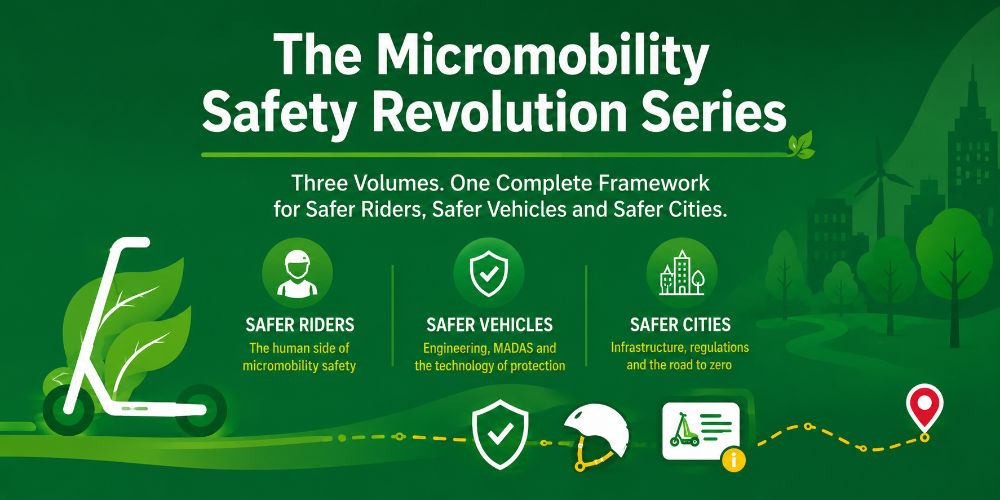
Three Books. One Complete Framework for Safer Riders, Safer Vehicles and Safer Cities.
Micromobility is changing how people move. E-bikes, e-scooters and other small electric vehicles offer cleaner, more affordable and more flexible transportation — but their rapid adoption has outpaced the safety systems needed to protect the people who ride them.
The Micromobility Safety Revolution is a three-volume series built around a simple idea: meaningful safety improvement cannot come from riders, vehicles or cities acting alone.
It requires all three.
The series brings together rider education, defensive-riding principles, vehicle engineering, advanced safety technology, infrastructure, regulation, insurance, policy and safety culture into one integrated framework for reducing collisions, injuries and fatalities.
Each volume examines a different part of the problem. Together, they provide a roadmap for moving micromobility safety from reaction to prevention.
Why This Series Matters
Micromobility has often been treated as either a transportation opportunity or a safety problem.
It is both.
E-bikes and e-scooters can reduce congestion, expand mobility and support more sustainable cities. But riders are physically exposed, vehicles provide little crash protection, and many people enter live traffic with limited training or understanding of the risks around them.
The answer cannot simply be more enforcement or more protective equipment.
The system itself has to become safer.
The Micromobility Safety Revolution provides a framework for doing exactly that — by addressing the human, the machine and the environment together.
Volume I — Safer Riders
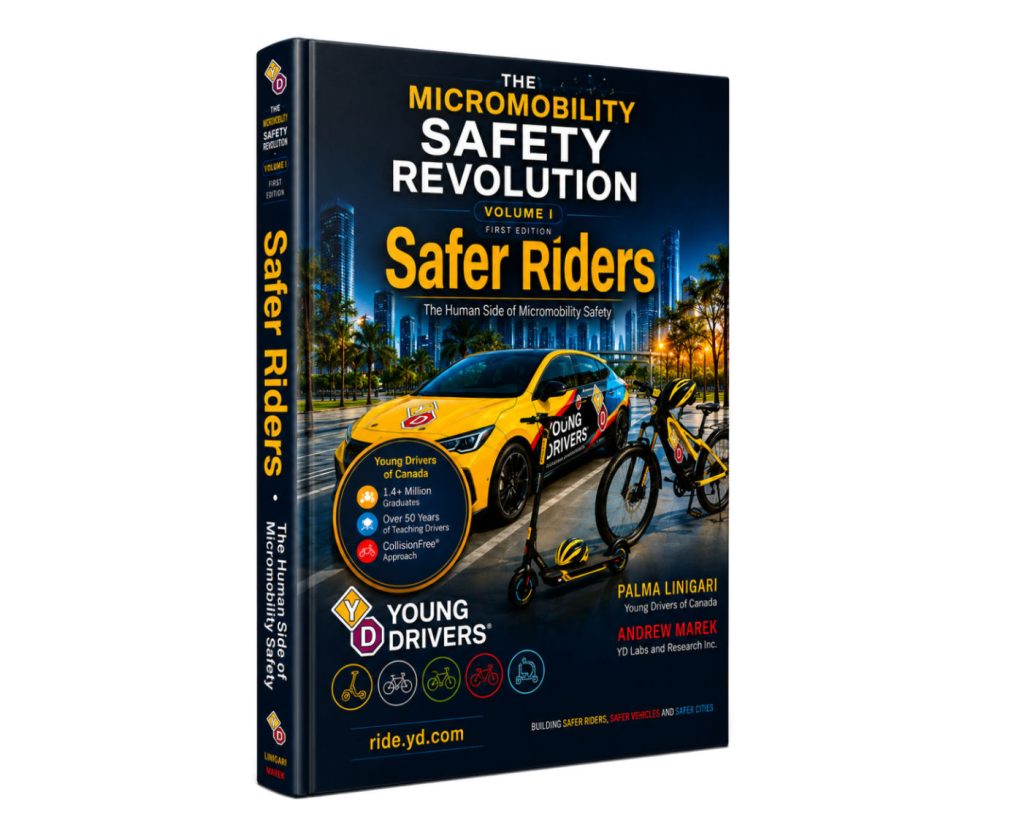
The Human Side of Micromobility Safety
Every collision begins before the moment of impact.
A rider fails to see a developing hazard. A driver misjudges the rider’s path. A surface defect appears too late. An intersection conflict develops faster than expected. Safer Riders focuses on the human skills that can interrupt that sequence before a collision forms.
Drawing on decades of behaviour-based road-safety experience, the volume examines how riders can be taught to recognize hazards earlier, anticipate the mistakes of others, manage space and make safer decisions in complex traffic environments.
Key Benefits of Volume I
1. Builds stronger hazard-perception skills
Moves rider education beyond knowing rules toward recognizing developing risks before they become emergencies.
2. Applies defensive-riding principles to micromobility
Shows how proven collision-avoidance concepts can be adapted for the unique challenges of e-bikes and e-scooters.
3. Explains why education must go beyond information
Rules and safety messages are important, but lasting behaviour requires practice, repetition and habit formation.
4. Addresses the training-access problem
Explores how mobile-first learning, simulation, gamification and AI-supported education can reach riders who may never attend a traditional classroom.
5. Introduces the Micromobility Safety Pyramid
Provides the foundational framework that connects rider behaviour with vehicle technology, infrastructure, regulation and safety culture.
The Benefit
Safer Riders helps transform the rider from a passive participant in traffic into an active collision-avoidance system.
Volume II — Safer Vehicles
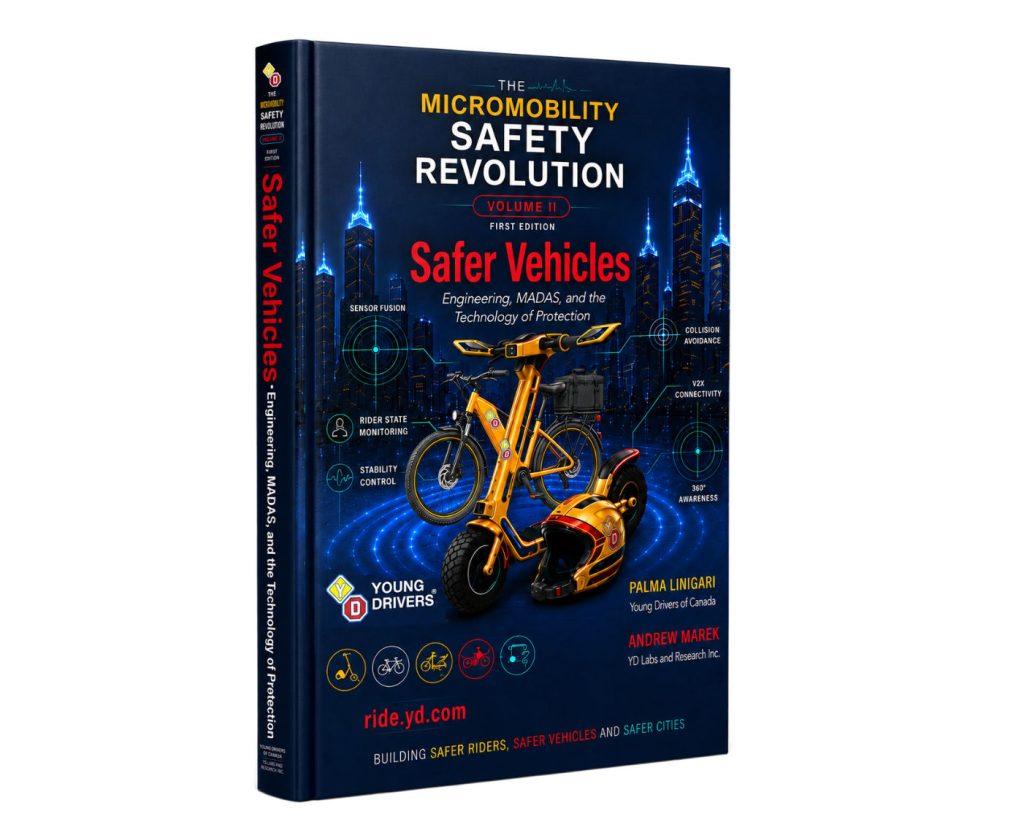
Engineering, MADAS and the Technology of Protection
A car can protect its occupants after a collision begins.
An e-bike or e-scooter largely cannot.
There is no steel passenger compartment, no crumple zone and no airbag separating the rider from the road. That creates a fundamentally different engineering challenge: A vehicle that cannot be made sufficiently crashworthy must increasingly be engineered not to crash.
Safer Vehicles examines how physical design and advanced technology can help prevent collisions, loss of control and rider error before they result in injury.
At the centre of the volume is MADAS — Micromobility Advanced Safety Systems, an original Level 0–5 framework for describing and comparing the protective capabilities of micromobility vehicles.
Key Benefits of Volume II
1. Provides a framework for evaluating vehicle safety technology
MADAS creates a common language for manufacturers, purchasers, fleets, regulators and riders to understand what protection a vehicle actually provides.
2. Examines safety from the ground up
Explores how wheel size, braking performance, geometry, centre of gravity and vehicle stability influence risk before electronics are added.
3. Explores collision-avoidance technology designed specifically for two wheels
Addresses why simply transferring automotive safety technology to e-bikes and e-scooters can create new risks.
4. Makes the case for improved braking and stability systems
Examines technologies such as anti-lock braking and graduated intervention that can help prevent common loss-of-control crashes.
5. Looks ahead without overstating the evidence
Explores rider-state monitoring, V2X connectivity, predictive AI and increasingly autonomous safety systems while distinguishing deployable technology from emerging concepts.
The Benefit
Safer Vehicles provides a blueprint for shifting micromobility design from simply moving the rider to actively protecting the rider.
Volume III — Safer Cities
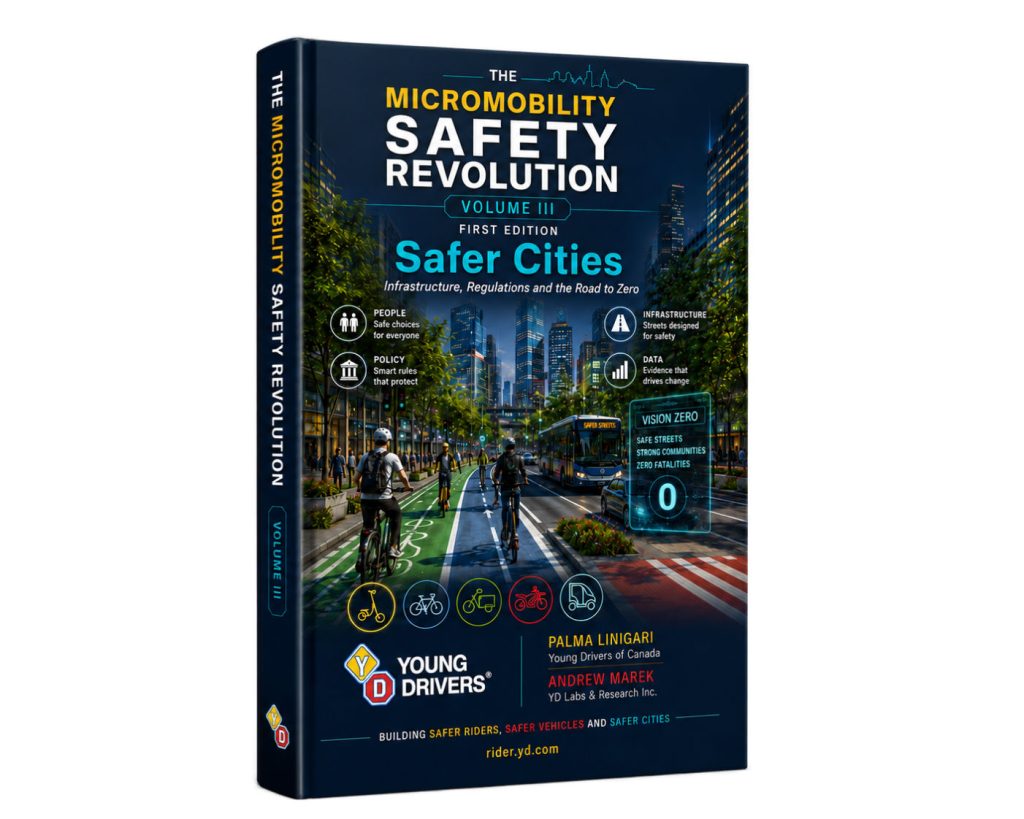
Infrastructure, Regulation and the Road to Zero
Even the best-trained rider on the safest available vehicle remains vulnerable inside a poorly designed system.
That is the challenge addressed by Safer Cities, the concluding volume of the series.
It examines the larger environment in which micromobility operates — the streets, infrastructure, regulations, commercial incentives, insurance systems, standards and cultural expectations that determine whether safe behaviour is supported or undermined.
Key Benefits of Volume III
1. Connects micromobility with Vision Zero principles
Applies the principle that human beings make mistakes and that transportation systems should be designed so those mistakes do not result in death or serious injury.
2. Explores safer infrastructure and urban design
Examines protected facilities, intersection design, network planning and smart systems that can reduce conflict between riders, vehicles and pedestrians.
3. Clarifies the regulatory challenge
Compares different approaches to e-bike and e-scooter regulation and examines why similar vehicles may be treated very differently between jurisdictions.
4. Connects safety with economics and insurance
Explores how fleet purchasing, insurance pricing, duty of care and regulation can make safer vehicles and safer practices commercially valuable.
5. Provides a roadmap toward zero fatalities
Brings the entire series together through a staged Zero-Fatality Roadmap, distinguishing actions that can be implemented now from longer-term technologies and systemic changes.
The Benefit
Safer Cities turns micromobility safety from a collection of individual measures into a coordinated system.
One Safety Problem. Three Essential Layers.
The strength of The Micromobility Safety Revolution is not simply what each volume contains.
It is how the three volumes work together.
Volume I — The Rider
See the danger. Predict the mistake. Avoid the collision.
Give people the perception, judgment and habits needed to prevent predictable crashes.
Volume II — The Vehicle
Engineer protection into the machine.
Design vehicles that support the rider, maintain stability, identify hazards and intervene intelligently when necessary.
Volume III — The City
Build a system in which mistakes are survivable.
Create infrastructure, rules, standards and incentives that support safer behaviour instead of relying on perfect riders.
The Complete Micromobility Safety System
A safer future does not come from choosing between education, technology and infrastructure.
It comes from combining them.
• A trained rider can compensate for what the vehicle cannot detect.
• A safer vehicle can catch risks the rider misses.
• A safer street can prevent both rider and vehicle errors from becoming catastrophic.
• Effective regulation can establish minimum expectations.
• Insurance and commercial incentives can accelerate adoption.
• Safety culture can make those improvements permanent.
That is the central benefit of the series: it replaces isolated safety initiatives with a coordinated prevention model.
Who Should Read the Micromobility Safety Revolution Series?
The series is designed for both the people making decisions and the people implementing them.
It is particularly relevant to:
- E-bike and e-scooter riders and parents seeking to better understand risk and prevention.
- Municipalities, transportation planners and policymakers developing micromobility strategies, bylaws and infrastructure.
- Vehicle manufacturers and technology developers designing the next generation of safer micromobility products.
- Fleet operators and shared-mobility providers making purchasing, training and risk-management decisions across large vehicle fleets.
- Insurers and risk professionals evaluating an emerging transportation category with rapidly evolving technology and exposure.
- Educators and safety organizations developing rider-training programs and public-safety initiatives.
- Researchers and advocates looking for an integrated framework connecting human factors, engineering and public policy.
From Collision Response to Collision Prevention
For much of transportation history, safety improvements followed tragedy.
A crash happened. Injuries accumulated. A weakness was identified. Standards eventually changed.
Micromobility has an opportunity to move faster.
The knowledge to prevent many collisions already exists. The technologies are developing. Infrastructure solutions are known. Digital education can reach riders at unprecedented scale.
What has been missing is a framework capable of bringing those pieces together.
The Micromobility Safety Revolution is that framework.
Volume I equips the rider.
Volume II engineers protection into the vehicle.
Volume III builds the safer system around them.
Three volumes. One goal: a future in which micromobility remains liberating, efficient and sustainable — without accepting serious injury and death as an unavoidable cost of the revolution.