
Nearly 700,000 emergency room visits. And almost every one of them was foreseeable.
Micromobility is the fastest change in urban transportation in a century – clean, affordable, liberating. But e-scooters and e-bikes arrived before the safety system that every other vehicle revolution eventually built. No license. No training. No rulebook. Just millions of new riders in live traffic, and an injury curve climbing year after year.
The public conversation reaches reflexively for bans, crackdowns, and enforcement. Safer Riders begins from a different premise: before the rider is a problem to be regulated, they are a person to be equipped.
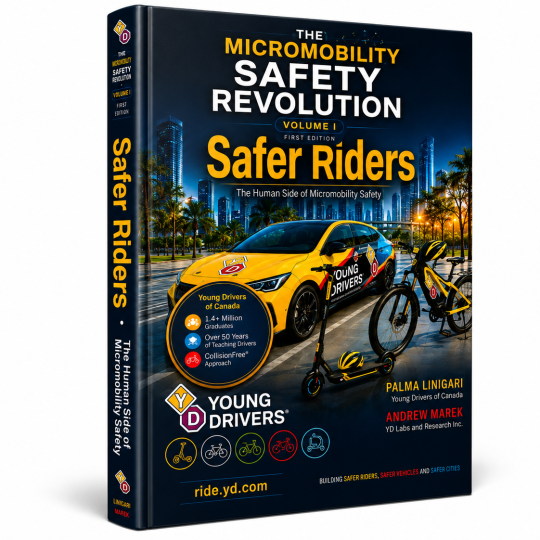
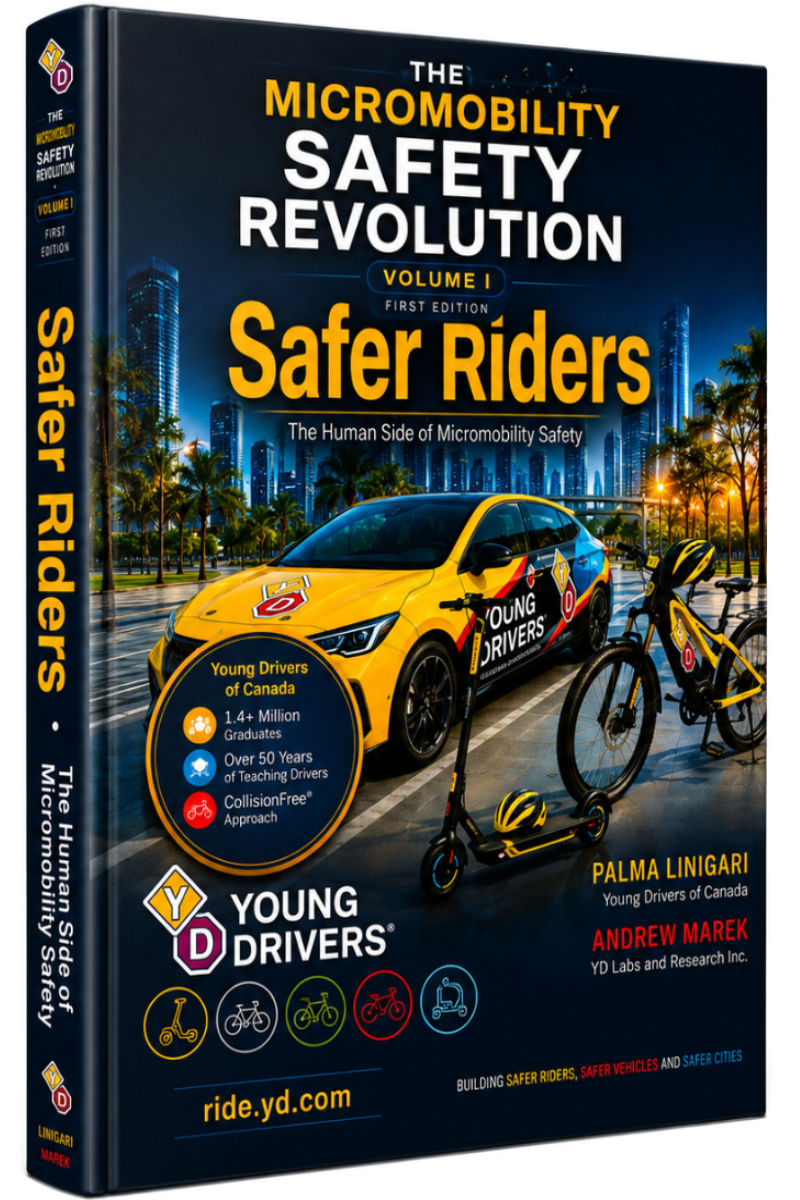
Drawing on five decades of behaviour-first safety doctrine from Young Drivers of Canada — the organization that has taught more than 1.4 million people to read a road and avoid a collision before it forms — this volume delivers the argument the micromobility field has been slow to act on: education is the missing safety system, and it can be built.
Across fourteen chapters, Safer Riders establishes a chain of four hard-tested claims:
The harm is real — and patterned. Riders are hurt in recognizable, recurring ways: the fall, the surface hazard, the intersection conflict, the dooring, the unseen rider. Crashes are not accidents. They are predictable – which means they are preventable.
The skills that prevent it are learnable. A century of driver-safety research shows what works and what doesn’t: information alone changes little, one-time courses decay, and skill training can even backfire. What reduces crashes is hazard anticipation, graduated exposure, and habit built over time – a proven doctrine, adapted here for two wheels.
The obstacle is reach, not knowledge. The riders at highest risk – the first-timer, the teenager, the tourist, the delivery rider – are exactly the ones no classroom will ever see. With no license to gate them, traditional training simply cannot get there.
Mobile-first delivery can. The connected device already in every rider’s pocket is the first channel capable of reaching an entire riding population – continuously, at the point of use, personalized, at near-zero marginal cost – extended by simulation, gamification, and AI held to the discipline of evidence.
The volume introduces the Micromobility Safety Pyramid, the six-layer framework that organizes the entire series, and includes a complete rider-education curriculum framework and glossary for practitioners ready to build.
Written for two readers at once – the decision-maker who sets policy, budgets, and standards, and the practitioner who must implement them – Safer Riders is rigorous enough for the expert and clear enough for the executive.
The revolution in how we move is already here. The revolution in how we keep riders safe is the one still waiting to happen. This is the blueprint.
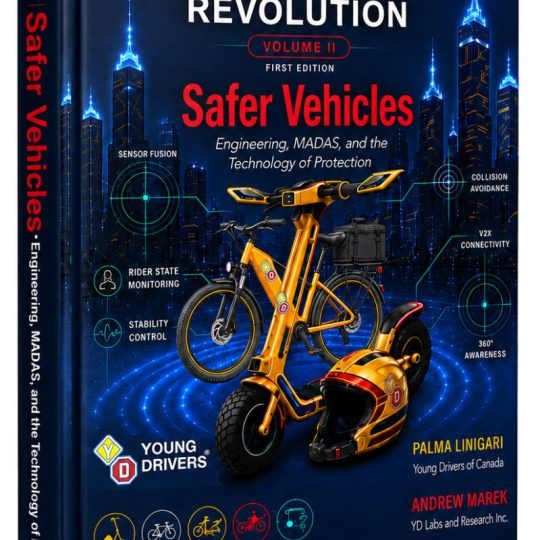
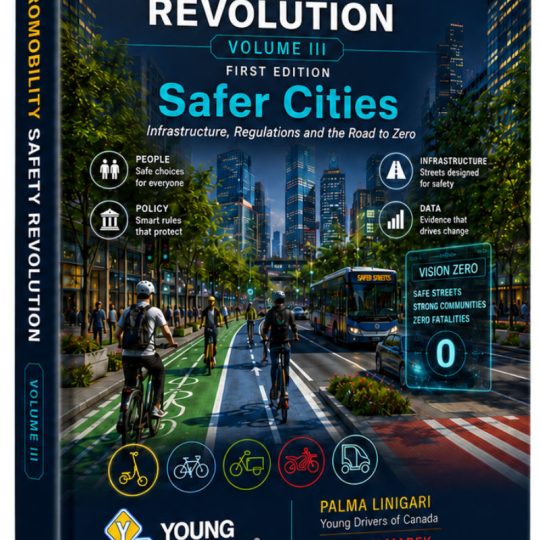
Volume I of The Micromobility Safety Revolution. Volume II, Safer Vehicles, engineers protection into the machine. Volume III, Safer Cities, builds the streets and rules around it.