

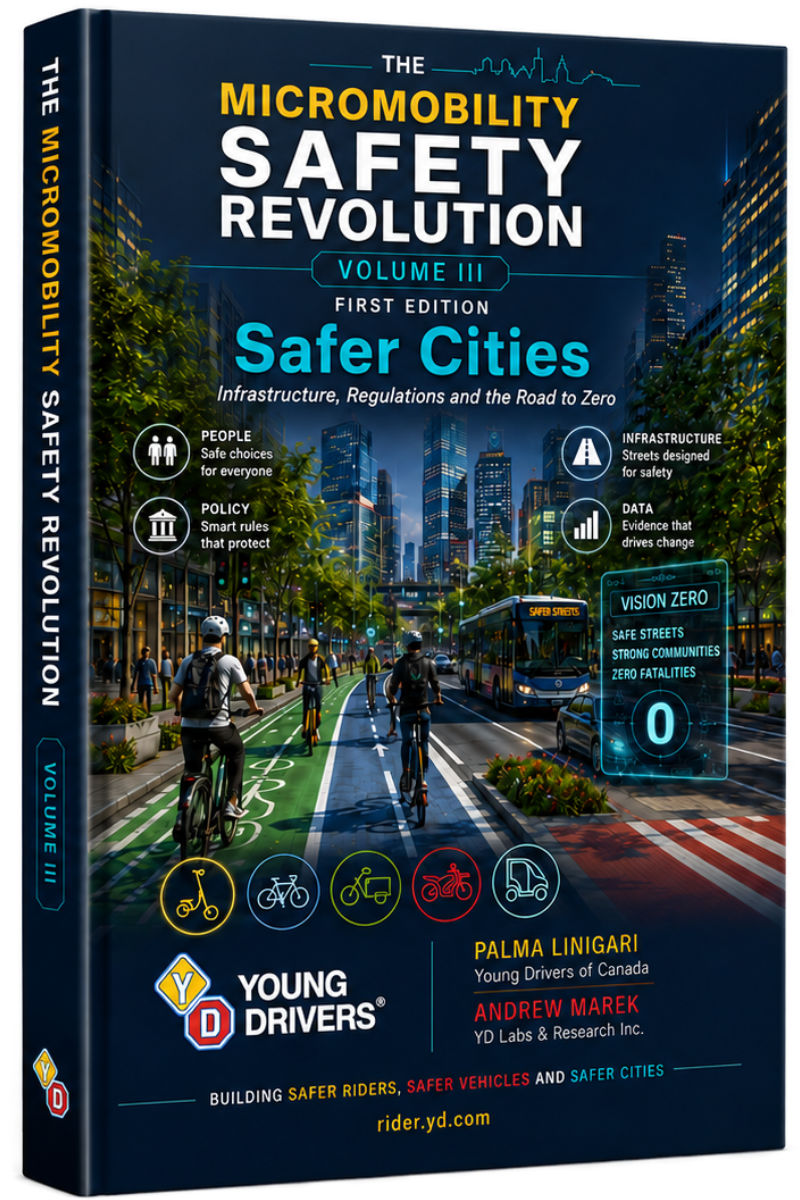
No rider and no machine can outperform a broken system. This is the book about fixing the system.
The automobile was not made survivable by better drivers or better cars alone. It took cities, standards bodies, insurers, and a culture that decided road death was not acceptable. Safer Cities — the capstone of the Micromobility Safety Revolution — applies that hard-won lesson to the fastest transportation shift in a century, and ends where the whole series has been pointing: at a credible roadmap to zero.
The volume climbs the final layers of the Micromobility Safety Pyramid in five movements:
Building safer cities. Protected infrastructure, urban design, smart systems — and Vision Zero, taken seriously: the principle that humans make mistakes, humans are physically vulnerable, and the system must be designed so errors are survivable. Because no one’s death is an acceptable price for someone else’s mobility.
Writing the rulebook. A clear-eyed tour of how Europe, North America, and Asia-Pacific actually regulate micromobility — why similar vehicles meet opposite fates under different rules, why North America’s scooter free-for-all happened, and the case for global MADAS standards that would let safety be specified, compared, and required.
Following the money. The business case for safety, the insurance coverage gap that quietly externalizes crash costs onto society, the leverage that fleet operators hold over thousands of vehicles at once — and how regulation, risk pricing, and duty of care can align commercial incentives with rider survival.
Growing the culture. Education ecosystems, national safety strategies, portable global rider certification, and the safety-culture movement — because mechanisms are held in place by the culture that wants them, and culture is the slowest layer to build and the last to fade.
The road to zero. The series finale: the Zero-Fatality Roadmap, a staged, honest assembly of everything the three volumes have built — near stages deployable today, far stages stated in the conditional — and the disciplined optimism that the elimination of micromobility death is not a noble aspiration but an achievable destination.
Written for the policymaker drafting the bylaw, the planner designing the street, the executive running the fleet, the insurer pricing the risk, and the advocate building the movement — Safer Cities is where the revolution’s argument becomes its plan.
The rider is ready. The machine is ready. This book is about making the world ready.
Volume III of The Micromobility Safety Revolution — the conclusion of the trilogy.
Reviews
There are no reviews yet.